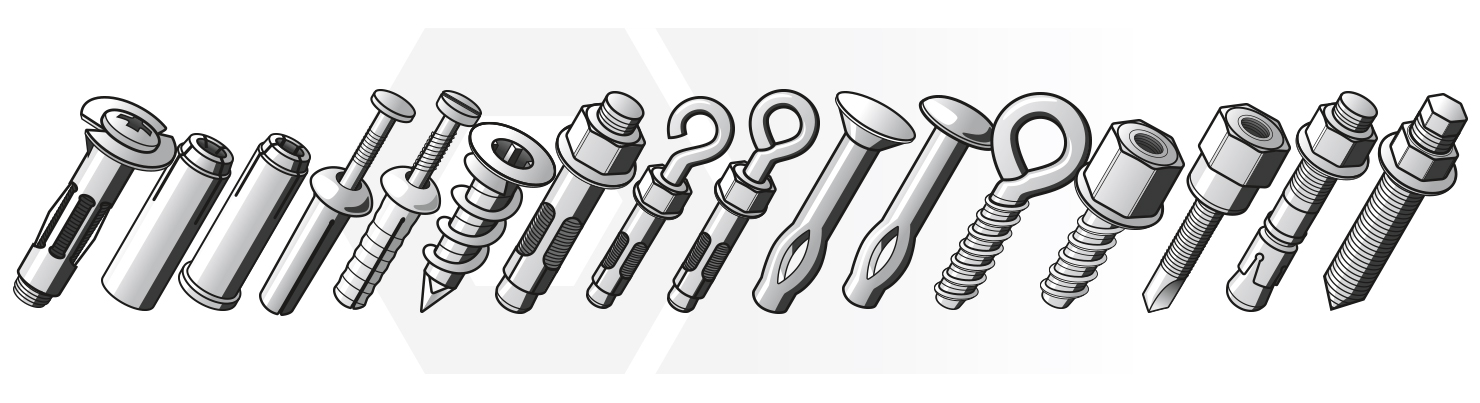
This resource presents a guide to selecting the best anchor for your construction needs. Anchor fasteners or anchors refer to fasteners that are specifically designed with mechanical properties that are suitable for use in both metal and base materials outlined in this resource. Learn more about the key differences between mechanical and chemical anchor fasteners.
In the construction industry, anchor fasteners or anchors, refer to fasteners that connect metal parts to a base material such as concrete or brick. They are specifically designed with mechanical properties that are suitable for use in both metal and these base materials. Anchor fasteners can be split into two categories: mechanical and chemical anchor fasteners.
Mechanical VS Chemical Anchors
A mechanical anchor such as a drop in anchor physically expands when it is tightened after being inserted into a hole in the base material. The expansion will cause it to grip the sides of the hole and create the necessary friction for a secure connection between the metal and the base material (usually concrete).
This is important, because, unlike metal, you cannot cut threads into construction materials like brick and concrete. Hence, there has to be alternative ways for these fasteners to be secured. The advantage of mechanical anchors is that they are easy to install. A potential issue with mechanical anchors is that the expansion of the bolt could cause the immediate surrounding concrete to crack. With chemical anchors, a resin is injected into the drilled hole in the concrete. This will fill up any empty spaces in the hole and create a secure, airtight connection. Chemical anchors are also called Chem Set Studs. The advantage of using chemical anchoring is that there is more flexibility with regards to the depth of the material and length of the fastener. You can use more resin if the fastener is slightly smaller than is required. However, the problem with chemical anchors is that they are a bit more complicated to use as you need to ensure that the resin is correct for the application and that it sets properly.
Selection of your anchor depends on things like load capacity, whether the connection needs to be permanent, depth of the base material, and what environmental conditions the connection is exposed to.
You also need to consider what will happen to the base material over time after installing your anchor. If there are a lot of vibrations and thermal expansion, the base material can crack. Most anchors will have specifications as to the type of base material and thickness needed.
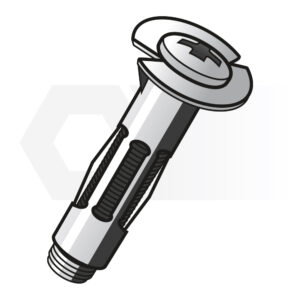
Hollow wall anchors are a two-part fastener that provides permanent threaded anchoring in hollow cavity walls, like drywall and plywood. They are mechanical anchors.
They consist of a screw or bolt that fits into a metal sleeve. The metal sleeve is surrounded by four flaps that fold in (similar to an umbrella stretcher) against the wall as you turn the bolt. The flaps have ‘teeth’ that clamp against the wall and create a secure anchoring. Once driven into the wall, the sleeve will remain securely fixed in the wall even after the screw is removed.
Applications:
Designed for fixing or hanging lightweight objects (photos, shelves, lightweight brackets, electrical fittings, etc) onto thin, hollow walls. The body or sleeve of the fastener will remain secure and fixed into the hollow wall, while the screw can be screwed in and removed when needed.
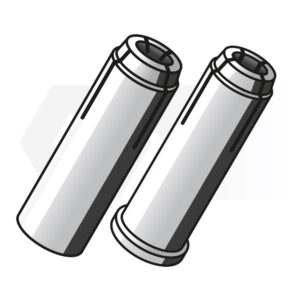
A drop-in anchor is a metal female threaded sleeve designed to be anchored into concrete. They are permanent, mechanical anchors that connect base materials such as concrete to metal parts.
You insert them into a pre-drilled hole (that is the same length as the anchor) in the concrete. As it is driven into the concrete by a setting tool inserted into the anchor, the anchor expands and creates friction against the concrete. They have very thin slits at the end, which allows the anchor to expand.
Applications:
They are used to connect any lightweight metal parts to concrete. Drop-ins are used to support things like lighting fixtures and piping.
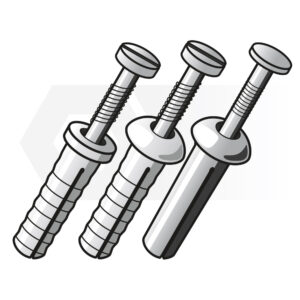
Pin anchors consist of two parts. The first part is a pin or nail and the second part is the metal or nylon sleeve the nail is inserted into. The metal sleeve features slots at the end which allows it to expand into a drilled hole and create friction against the material. Its purpose is to provide a secure metal base to insert a nail into a base material like concrete, brick or stone. They are mechanical anchors that offer permanent connection.
To use it, you insert the metal sleeve with the nail into a pre-drilled hole in the base material. As you hammer the nail in, it will cause the metal sleeve to expand against the base material and create friction. There are some important things to consider when using these. The first is the depth of the material when deciding the depth of the pre-drilled hole. It cannot be too deep if the base material is thin. The second factor is the spacing between the anchors. If they are too close together, it can cause cracks in the base material. It is good to keep a spacing of at least 5 anchor diameters between the anchors.
Applications:
Ideal to fix lightweight brackets, electrical fixtures and other metal parts onto brick or stone. Milsons offers sleeves made from either metal (for harder base materials) or nylon for softer materials.
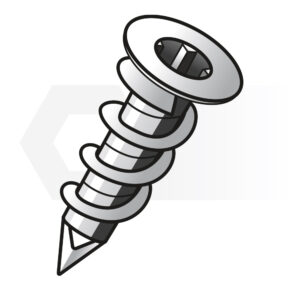
Plasterboard anchorsare self-drilling screws that are designed to be used in softer materials like plasterboard, and used to hold lightweight objects on walls like a clock or mirror. In appearance, plasterboard anchors look like really large screws with widely-spaced threads. They are self-drilling screws that can come in both metal and non-metal materials like nylon. They are both robust and lightweight, which are ideal characteristics for plasterboard.
Applications:
Ideal for installing lightweight objects on plasterboard. They are used to hold things like framed pictures, mirrors, and clocks. To install, you need to drill a small hole into the plasterboard (about the same diameter as the anchor tip), and drive it into place using the drill until the anchor head is flush with the wall.
Sleeve anchors are very versatile anchors that can be used in a number of heavy-duty applications in harder construction base materials like concrete and brick. They are long fasteners that have metal flaps or ‘sleeves’ towards the end of the bolt. As the bolt is tightened, the flaps push against the walls of the hole to secure the anchor in place. The end of the fastener is flat.
Applications:
Sleeve anchors are fasteners that are used to secure objects onto concrete, brick or block. They are suited to medium-duty applications with concrete. E.g. installing grab bars in bathrooms or rails in stairways.
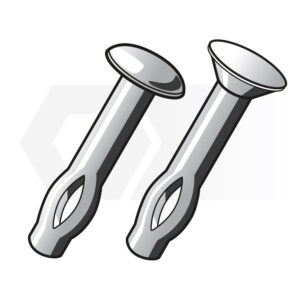
Split drive anchors are permanent fasteners that have either a countersunk or rounded bolt head at the top and flattened metal fins at the end, which act as the expansion mechanism. They are a one-piece mechanical anchor that can be used in base materials like concrete and block. They are typically made from carbon steel. These anchors should be spaced a minimum of ten anchor diameters from each other, to prevent cracking of the base surface.
Applications:
Split drive anchors are versatile anchors that can be used in a variety of base materials: concrete, stone, brick, block, etc. They can attach light to medium-weight fixtures onto these materials and are suited to permanent installation or applications that require tamper-proofing.
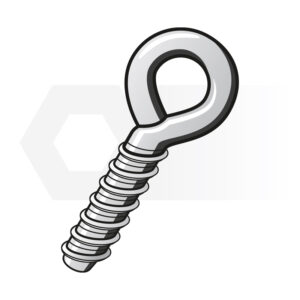
Screw eyesare threaded fasteners with a metal loop at the end which is used to hang lightweight objects like picture frames. They are self-tapping screws that can cut into softer materials such as plasterboard and wood.
Applications:
To hang lightweight objects such as picture frames, clocks, decorations, etc.
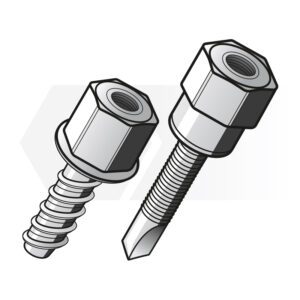
Threaded rod anchorsare fasteners that have a small threaded hole in the fastener’s head which can be vertical or horizontal, which is used to engage a threaded rod. The shaft of the anchor is threaded and comes with three different threads, suitable to fit into a base material like concrete, wood or steel.
Applications:
Threaded rod anchors are used to suspend threaded rods from a base material like wood, steel, brick or concrete in overhead applications.
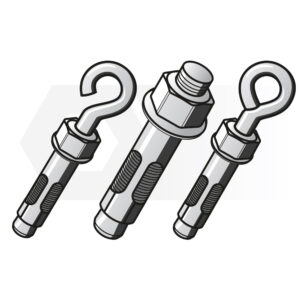
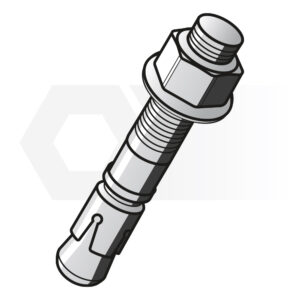
Through Bolts,also known as Wedge Anchors, are threaded expansion anchors that are used to connect medium to heavy weight fixtures to concrete. The anchors consist of four parts: threaded shaft or body, nut, washer and expansion sleeve. They are one of the strongest heavy-duty mechanical anchors.
Applications:
Through Bolts are specifically designed to connect heavy objects to solid concrete. They will not work with other porous or hollow materials like plasterboard or brick.
Installation Info:
Through Bolts are also permanent, so cannot be removed once inserted into the pre-drilled hole. The installation requires hammering of the anchor into the hole in the concrete, followed by tightening the nut at the top. This causes the expansion sleeve to move outward and create friction with the hole’s walls.
To select a through bolt, you need to find the required holding value. You also need to consider the torque to tighten the nut.
General things to consider when installing through bolts to prevent cracks in the base material:
Adequate space between unsupported edge and anchor. Generally, the anchor should be at least five diameters away from the unsupported edge.
Adequate space between anchors. Generally, through bolts would be at least ten diameters away from each other.
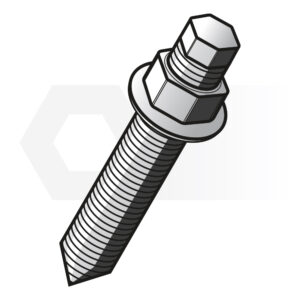
Chem Set studsare chemical anchors where the bolt or stud uses a resin-based adhesive to bond to a base material such as concrete. The resin acts as a glue to hold the bolt in place of the expansion mechanism used in mechanical anchors. Chem Set Studs have several parts: threaded shaft or body, nut and washer.
Applications:
Chem Set Studs are good for applications where mechanical anchors are unsuitable, such as risk of fracturing.
The resin is very important here because it is the only thing securing the stud in place. It is important to factor in temperature when installing chemical anchors. Curing times increase with a decrease in temperature. On average, the curing times are around 20 minutes at 35O C and 60 minutes at 15OC.
The data provided in this document is for general guidance only and should not be solely relied upon when working to stringent specifications. We recommend consulting with qualified experts regarding any technical queries. This may change without written notice