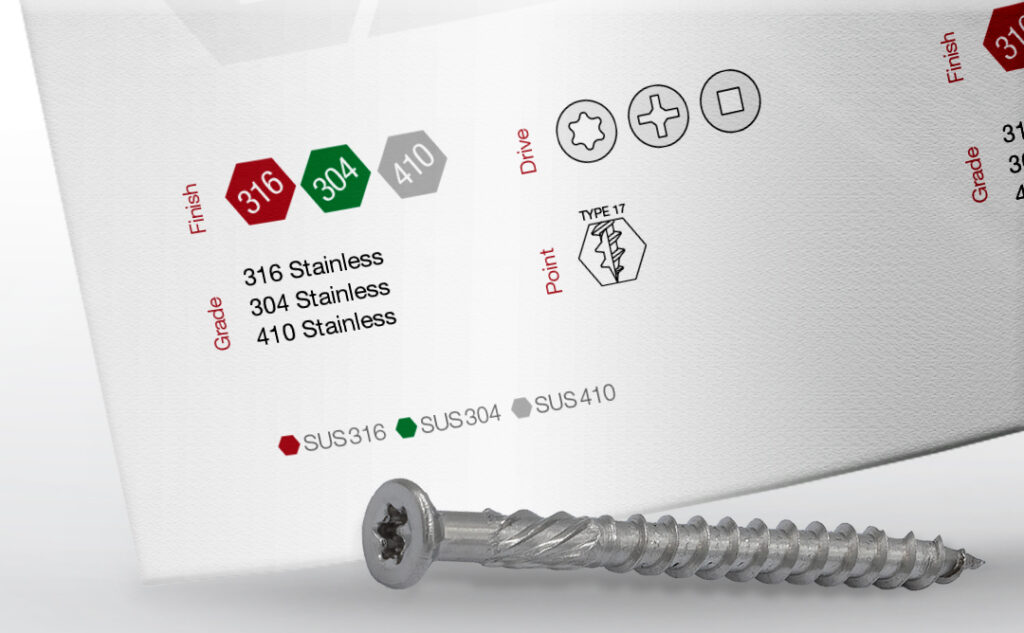
Stainless steel fasteners are a top choice for construction, engineering, and industrial projects thanks to their corrosion resistance, durability, and strength. However, not all stainless steels are the same. Understanding the differences between 304, 316, and 410 grades is critical for selecting the right fastener for your environment and application.
Key Composition Differences
Stainless steel, an alloy of iron with at least 10.5% chromium, is prized for its strength, corrosion resistance and long service life. Alloying elements such as nickel and molybdenum improve strength and performance, making it viable for engineering, marine and architectural applications.
One of the differences between T304 and T316 stainless steel is the addition of molybdenum in 316, which in combination with chromium provides superior protection against chlorides, saltwater, and harsh chemicals. This makes T316 the better choice in corrosive or coastal conditions, while 304 is a cost-effective solution for general-purpose use.
Nickel is a critical alloying element in stainless steel, particularly in austenitic grades like T304 and T316. It plays a major role in shaping the steel’s structure, corrosion resistance, and formability and has good wear resistance. Grades like T316 (which contains ~10–14% nickel) are more expensive than T304 (with ~8%) and T410 ((~0.75%) due to both the increased nickel content and the addition of molybdenum.
T410 has higher carbon content which acts as a strengthening element, allowing 410 stainless steel to be hardened through heat treatment for better wear resistance. Due to its higher hardness after heat treatment, 410 stainless steel fasteners offer enhanced abrasion and impact resistance. This is especially beneficial in environments where fasteners may experience friction, movement, or physical contact.
Composition
| Feature | 316 Stainless Steel | 304 Stainless Steel | 410 Stainless Steel |
|---|---|---|---|
| Chromium | ~16–18% | ~18% | ~11.5–13.5% |
| Nickel | ~10–14% | ~8% | Low (~0.75%) |
| Molybdenum | ~2–3% | No | No |
| Carbon | Low (~0.08%) | Low (~0.08%) | Higher (~0.15%) |
| Magnetic | Non-magnetic | Non-magnetic | Magnetic |
Comparison of key properties
| Feature | 316 Stainless Steel | 304 Stainless Steel | 410 Stainless Steel |
|---|---|---|---|
| Corrosion Resistance | Superior resistance to chlorides, saltwater, and harsh acids due to the addition of molybdenum | Excellent overall resistance, but susceptible to pitting and crevice corrosion in chloride and saltwater environments | Moderate – less corrosion resistant; suitable for dry indoor use |
| Cost | More expensive, typically 20–30% higher, because of the higher nickel content and added molybdenum | More economical and widely available | Lower than 304 and 316, but varies based on application |
| Application | Marine environments, chemical processing, medical equipment, and other applications with exposure to harsh chemicals | General-purpose use, including kitchen equipment, sinks, food and beverage processing, and architectural trim | Dry interior use, self-drilling screws, high-strength applications |
| Heat Resistance | Slightly better resistance to oxidation and scaling at high temperatures | Good heat resistance | Limited – can lose corrosion resistance at elevated temperatures |
| Strength and Hardness | Generally stronger, with higher tensile and yield strength, due to the molybdenum content | Good strength, though can be hardened by cold working | High hardness and strength – can be heat treated for wear resistance |
Which stainless steel should you choose?
The right stainless steel fastener depends on your environment, load requirements, and exposure conditions.
| 316 | 304 | 410 |
|---|---|---|
| Use 316 Stainless Steel when corrosion resistance is critical | Use 304 Stainless Steel for more general cost-effective applications | Use 410 Stainless Steel when strength and hardness are the priority |
| Marine and coastal environments — ideal for saltwater exposure; resists pitting and tea-staining | Indoor and sheltered outdoor environments | Self-drilling and self-tapping screws — excellent for penetrating steel and timber |
| Chemical and industrial processing — withstands acids and harsh chemicals | Furniture, kitchens, and architectural hardware | Interior structural fixings where corrosion exposure is minimal |
| Medical and food processing equipment — hygienic and easy to clean | Projects where cost-efficiency is a key factor | Applications requiring wear resistance and high mechanical strength |
| Submerged or consistently high-moisture environments | Dry, inland construction or DIY projects | Ideal for environments that are dry or low in humidity, such as workshops or machinery assembly |
Fastener-Specific Considerations
- Galling: Both 304 and 316 stainless steels are prone to galling under pressure or high-speed installation. Use lubricants, reduce driving speed, or mix grades (e.g., 304 bolt with 316 nut) to reduce risk.
- 410 Stainless Steel is less prone to galling due to its harder composition but is also more brittle—avoid over-torquing during installation.
- Mixing Grades: Can be acceptable in low-corrosion environments, but monitor carefully to avoid galvanic corrosion between dissimilar alloys.
- Surface Finish: A polished or passivated finish enhances corrosion resistance across all stainless grades, particularly in exposed environments.Lorem ipsum dolor sit amet, consectetur adipiscing elit. Ut elit tellus, luctus nec ullamcorper mattis, pulvinar dapibus leo.
Summary
- Choose 316 when working in coastal, marine, chemical, or wet conditions where high corrosion resistance is critical.
- Choose 304 for general use, where cost efficiency and reliable corrosion resistance are needed in non-aggressive environments.
- Choose 410 for applications requiring hardness and high strength such as self-drilling screws or fasteners going into steel — best used in dry or protected environments due to its lower corrosion resistance.
- Always consider the location, moisture exposure, load-bearing needs, and risk of corrosion when specifying stainless steel. fasteners for your application.

The data provided in this document is for general guidance only and should not be solely relied upon when working to stringent specifications. We recommend consulting with qualified experts regarding any technical queries. This may change without written notice
Version No: 251017